+ 44 203 372 4609
 Logicsimplified
 Get a Quote



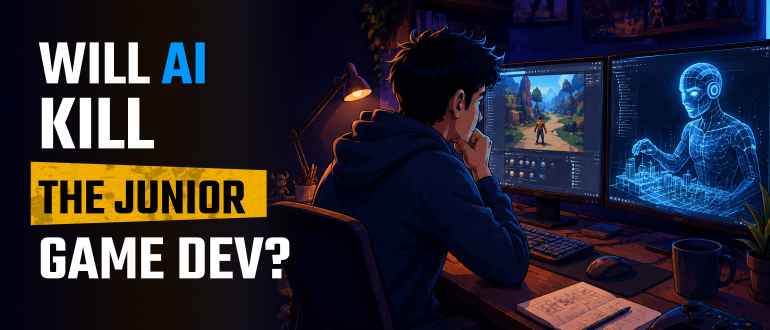
The gaming industry is currently standing at its most significant crossroads since the transition from 2D sprites to 3D polygons. As we move through 2026, a singular, polarizing question dominates every studio boardroom, Discord server, and university classroom: Will AI replace developers?
For those just entering the field, the anxiety is palpable. The traditional path to becoming a veteran creator (starting in the trenches of manual labor) is being rewritten in real time. Understanding the nuances of AI in game development is no longer an optional skill; it is the fundamental requirement for survival in the modern workplace.
Understanding the Foundation: What is AI in Video Games?
To address the future of the workforce, we must first define the technology. When people ask, "What is AI in video games?", they often think of smarter enemy NPCs or more realistic pathfinding. While those elements remain, the AI of 2026 has moved "upstream" into the production pipeline itself.
Today, AI game programming involves sophisticated Large Language Models (LLMs) and diffusion agents that are integrated directly into engines like Unity and Unreal. These tools aren't just playing the game; they are helping build it. They manage everything from generating boilerplate C++ code to real time debugging of complex physics interactions. This shift is the catalyst for the changing landscape of junior game developer jobs.
The Rise of Vibe Coding in Gaming
The most disruptive trend of the current year is undoubtedly vibe coding in gaming. This term refers to a high level approach to development where the creator focuses on "intent" rather than "syntax."
In a traditional setting, an entry level developer might spend three days manually scripting a character’s movement mechanics (adjusting jump heights, gravity constants, and acceleration curves line by line). With vibe coding, that same developer provides a natural language prompt: "I want the movement to feel heavy and momentum based, like a knight in full plate armor, with a slight landing lag that emphasizes the weight."
The AI then generates the foundational logic, particle hooks, and sound triggers to match that "vibe." This doesn't mean the code isn't being written; it means the machine is handling the "how" while the human focuses on the "what." This transition is fundamentally altering entry-level developer roles, shifting them from manual executors to creative directors of localized systems.
Logic Simplified combines game dev expertise with vibe coding to give you a 70% savings advantage.

Will AI Replace Developers? The Reality of 2026
The question of "will AI replace game app developers" cannot be answered with a simple yes or no. Instead, we are seeing a "replacement of tasks" rather than a "replacement of people."
The roles most at risk are those that rely on repetitive, low complexity outputs. In the past, studios hired a fleet of junior devs to handle "grunt work" (cleaning up UV maps, writing basic UI scripts, or manual regression testing). In 2026, generative AI for games has become so efficient at these specific tasks that the demand for "pure" manual coders has plummeted.
However, this has created a massive surge in demand for "Augmented Developers." These are creators who can use AI in game development to do the work of five people. The industry isn't shrinking; its output capacity is expanding.
The 2030 Horizon: How Many Jobs Will AI Replace?
Looking further ahead, many ask, "How many jobs will AI replace by 2030?" Economic analysts within the gaming sector suggest that by the end of the decade, nearly 40% of traditional task based roles will be fully automated.
But there is a silver lining. The history of technology shows that as the cost of production drops, the volume of production increases. As AI game programming makes it cheaper to build high fidelity worlds, more studios will form, more games will be greenlit, and more "Architect" roles will open up. The game dev career outlook 2026 and beyond suggests that while the "Junior" title may stay the same, the responsibilities will look more like what we used to call "Senior" or "Lead" responsibilities.
Empowering the Crowd: AI and Community Driven Design
One of the most positive shifts is how AI tools amplify community-driven game design. Historically, there was a massive technical wall between a player having a great idea and that idea appearing in a game. Generative AI for games is tearing that wall down.
Community creators can now use AI to build high quality mods, levels, and even total conversions with minimal coding knowledge. Professional studios are leaning into this, using AI to bridge the gap between player suggestions and technical implementation. This creates a collaborative ecosystem where the developer acts as a curator of community creativity, guided by AI driven data analysis.
The New Skillset for Junior Game Developer Jobs
If you are a student or a hobbyist looking at the current game dev career outlook 2026, your roadmap needs to change. Knowing how to write a script in C++ is no longer enough. To secure entry-level developer roles, you must demonstrate mastery in the following areas:
1. AI Orchestration: Can you lead a "fleet" of AI agents to build a functioning prototype in a weekend?
2. Logic Verification: AI can write code, but it can also "hallucinate." Your value lies in your ability to read AI generated logic and spot the architectural flaws that a machine might miss.
3. Systemic Design: AI is great at individual components but struggles with "The Big Picture." Learning how different systems (economy, combat, social) interact is where human intelligence still reigns supreme.
4. Prompt Engineering for Creators: This is the language of vibe coding in gaming. Learning how to communicate precise creative intent to an AI is a technical skill in itself.
Conclusion: The Evolution of the Creator
So, will AI replace developers? Only those who refuse to evolve.
The era of the "Code Monkey" is ending, and the era of the "Creative Technologist" has begun. AI in game development is a powerful tool that, when placed in the hands of a skilled human, allows for the creation of experiences we couldn't even dream of a decade ago.
Whether it is through vibe coding in gaming or the democratization of community-driven game design, the technology is empowering more people to tell their stories. The challenge for the next generation of developers is not to fight the machine, but to learn how to lead it.
At Logic Simplified, a leading game development company in India, we believe that the human element is the soul of every game. Our approach to staff augmentation and game development services focuses on "Augmented Intelligence" (combining the speed of AI with the irreplaceable heart of human creativity). Get in touch with us to take the conversation forward, and know what we are up to. Write to us at enquiry@logicsimplified.com.