+ 44 203 372 4609
 Logicsimplified
 Get a Quote



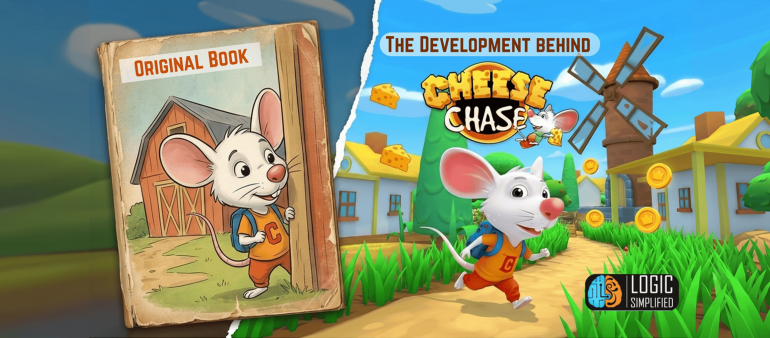
A client came to Logic Simplified with a story and a goal. The story was a children’s adventure book about Nostril, a mouse with an extraordinary sense of smell and an unusually sophisticated taste in cheese, and his rival, a rat named Roscoe. The goal was to turn that world into a game players could pick up and enjoy within seconds.
This game development case study follows the project through each phase of our development cycle, from the first brief to launch. It shows how we approach hyper casual game development when the source material is a book.
Phase 1: Discovery and Requirements
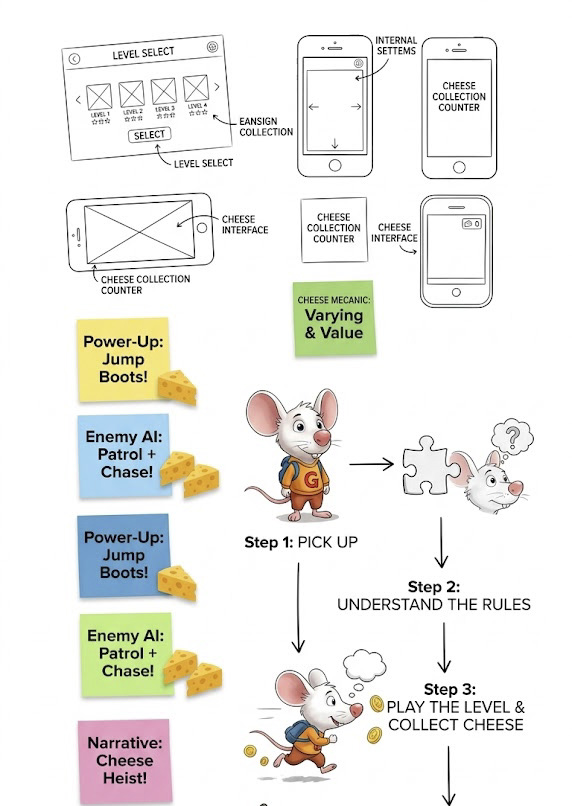
Every project starts with listening. The client’s vision was clear:
- A hyper casual game for iOS
- Unity as the core technology stack
- Five environments merged into one continuous running experience
- A game that is quickly playable, intuitive and addictive enough for “one more run”
The client summed it up as “quickly playable, no brainer, time saver, addictive.” We treated that as a design principle for the whole project: pick it up, understand it, play it, try again.
The second requirement mattered just as much. The game had to feel like the book, so Nostril couldn’t simply run through a generic obstacle course. His journey, enemies and environments had to stay connected to the original story.
Phase 2: Pre-Production and the Game Design Document
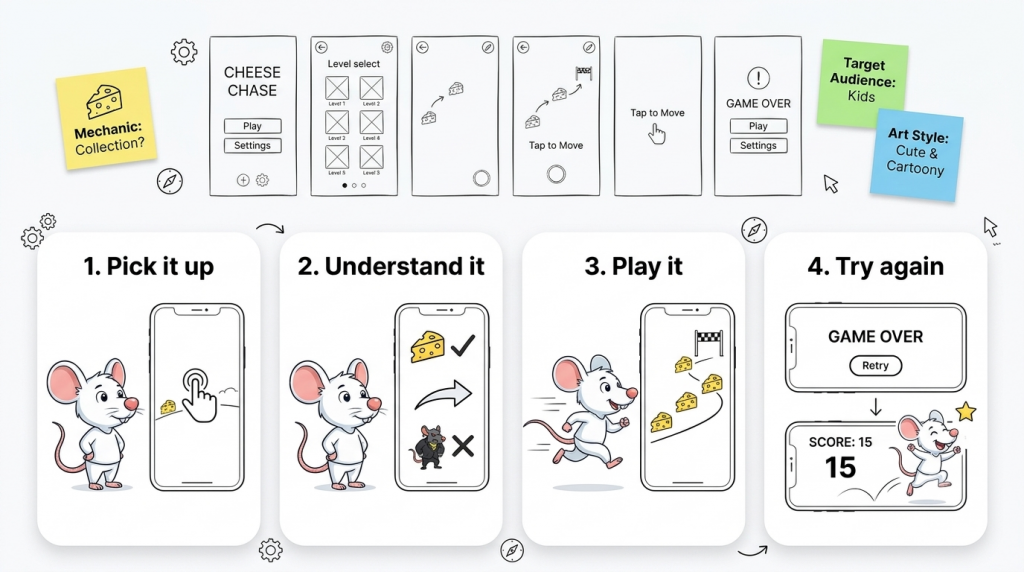
A book can spend pages describing a journey, while a hyper casual game has a few seconds to explain itself. So the first job in pre-production was deciding what stays in the story and what becomes gameplay.
We agreed on the essentials with the client: Nostril runs, cheese is collected, obstacles are avoided, and Roscoe and his minions must be escaped. The story became the foundation, and gameplay became the way players experience it.
We captured these decisions in the Game Design Document (GDD), which became the single reference for designers, developers and the client. It defined:
- The core loop of run, collect, dodge and retry
- Swipe controls that need no tutorial
- Hyper casual game mechanics such as power-ups, scoring and progression
- The structure and difficulty curve of the five worlds
The GDD also protected the scope. In hyper casual game design, every extra mechanic risks making the game less hyper casual, so we agreed on what to leave out as well.
Phase 3: Art and Asset Production
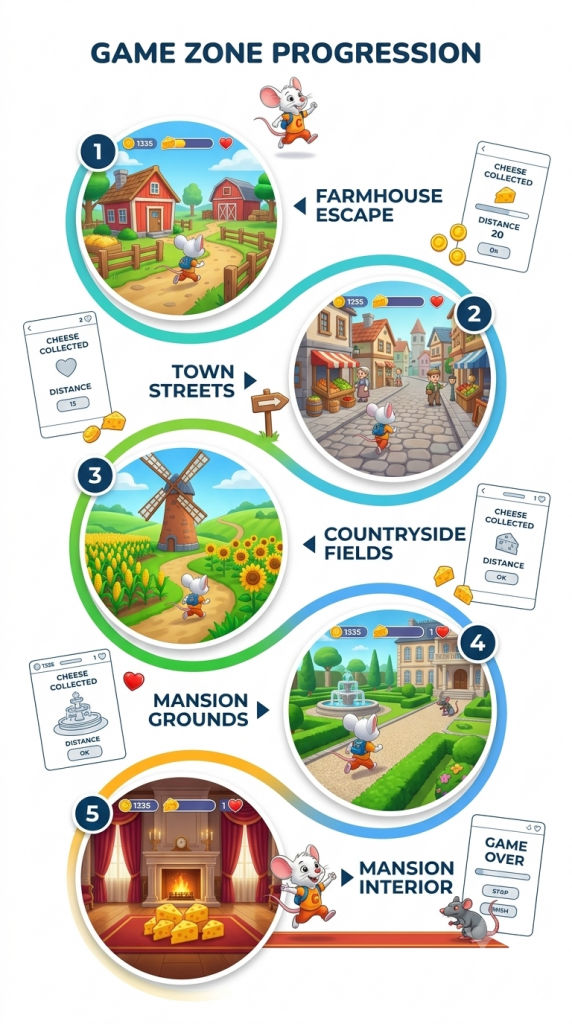
With the GDD approved, our design team took on the 3D game development work. The project had eight designers, and they were responsible for much more than making the game look good. They shaped Nostril, Roscoe and his minions, along with obstacles, collectibles, UI and animations.
The five environments were:
- Farmhouse Escape
- Town Streets
- Countryside Fields
- Mansion Grounds
- Mansion Interior
Five environments sounds manageable until they have to connect smoothly during continuous play. The visual language, obstacles and rhythm had to carry from one world to the next, so the player never felt they had entered a different game.
We held the art to one test: could a player understand danger and opportunity in a fraction of a second? Cheese had to look like something you want, traps like something you avoid, and Roscoe like someone to run from.
Phase 4: Programming and Development in Unity
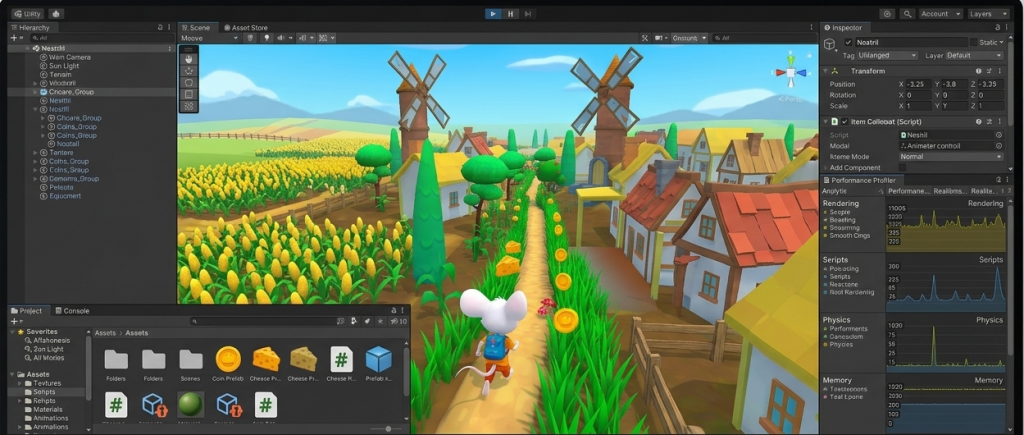
Unity became the home for everything: the 3D environments, gameplay mechanics, animations, UI and interactive elements. For Unity game development aimed at both platforms, the advantage is that one codebase can serve Android and iOS, which suited the client’s plan.
Two backend developers and one frontend developer worked alongside the designers to build:
- The player controller: swipe input that responds correctly every time
- Obstacle and collectible systems: consistent behavior and fair placement
- Environment transitions: smooth changes between worlds mid-run
- Power-ups, scoring and progression: the systems that add replay value
- Supporting functionality behind the game
In a game this simple there is nowhere for a bug to hide. A player who swipes at the right moment expects the game to respond, every time. If you are wondering how to make a mobile game in Unity, our answer from this project is to get the core run feeling right first, then build everything else around it.
If you’re looking for top Unity developers for your game idea, look no more.

Phase 5: Level Design and Integration
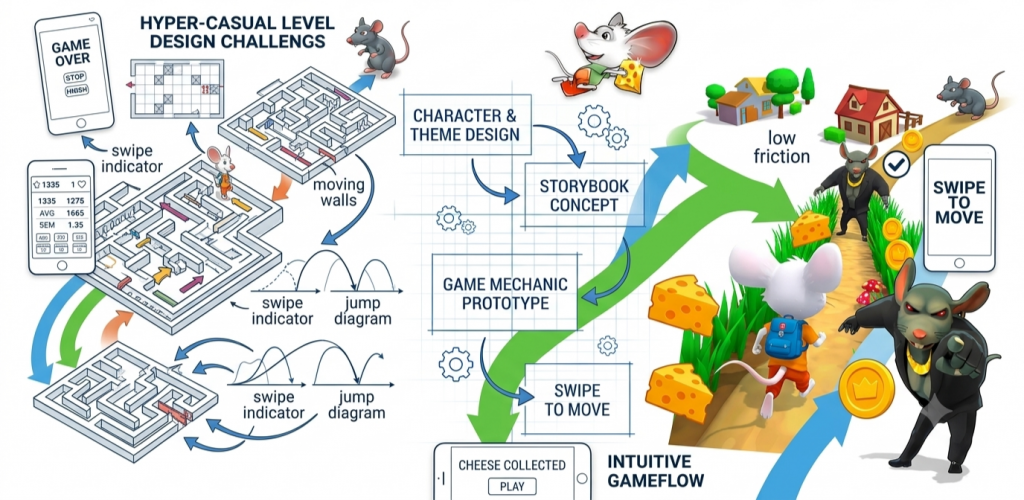
The biggest challenge of the project wasn’t creating five environments. It was making them playable.
Our game level design had to balance three things at once: simplicity, challenge and repeatability. If the game was too easy, it became predictable. If it was too hard, players would leave, and with too many mechanics it would stop being hyper casual.
Our designers kept returning to the same questions:
- Where should an obstacle appear?
- How much space does the player need to react?
- When should the environment change?
- How difficult should the next section be?
- Where should the cheese go?
- Would a player understand what to do without being told?
We answered them by testing and adjusting obstacle placement, paths and transitions over and over, then integrating the art, code and levels into a single playable build.
Phase 6: Testing and Refinement
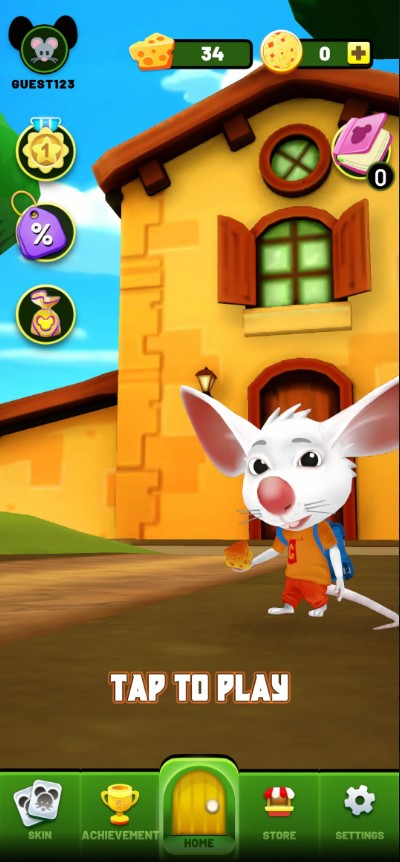
Because the game is designed to be intuitive, every interaction matters. Our testing covered gameplay functionality, UI behavior, environment transitions, obstacle interactions and overall player flow.
The cycle never changed: identify an issue, refine the experience, test again. There is nothing quite as frustrating as dodging a mousetrap perfectly and discovering the game had other plans, so we worked to make sure obstacles behaved the same way every time.
Over approximately six months, this loop took the project from the initial requirement to final delivery and turned separate pieces into one coherent endless runner game.
Phase 7: Launch and Deployment
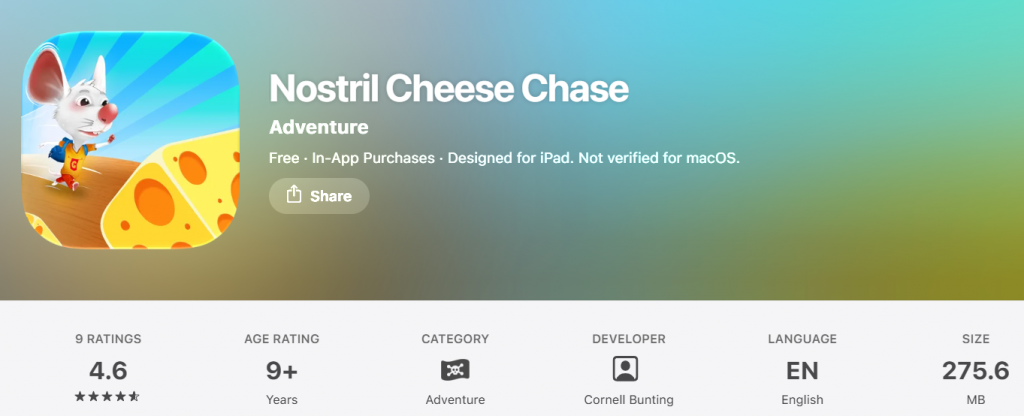
Once the build was stable, the focus moved to release. Our deployment process covers:
- Final iOS builds with device compatibility checks
- Store listings the App Store, including icon, screenshots and preview video
- Meeting each platform’s review and policy requirements
- A soft launch where appropriate, to catch issues before a full release
Phase 8: Marketing and Post-Launch Support
A finished game still needs players to find it. For hyper casual titles, the main levers are App Store Optimization, short video clips and social media. A book-based game also has a natural first audience in readers of the original story.
After launch, analytics show where players drop off, which lets updates improve those moments and keep the game worth returning to.

What the Project Taught Us
The most interesting part of this project was the translation. A story written for readers had to become an experience designed for players. A character’s personality had to become gameplay, and five environments had to become one continuous journey.
The finished game stayed true to the client’s original goal: something players can open, understand quickly, play without a learning curve and return to for another run.
Have a Story or Idea? Build It with Logic Simplified
Turning Cheese Chase from a book into a mobile game took game design, 3D art, level design, Unity development and testing working together. Logic Simplified brings experience across the full game development lifecycle, so whether you have a book, a brand, an original concept or a rough idea, we can help you:
- Shape your concept and write the GDD
- Design characters, environments and UI
- Build your game in Unity for Android and iOS
- Create levels that are simple, challenging and replayable
- Test, refine and prepare your game for launch
Have an idea for an endless runner or hyper casual game? Get in touch with Logic Simplified at enquiry@logicsimpified.com , or get in touch here. Let’s give your idea a very good reason to keep running.