+ 44 203 372 4609
 Logicsimplified
 Get a Quote



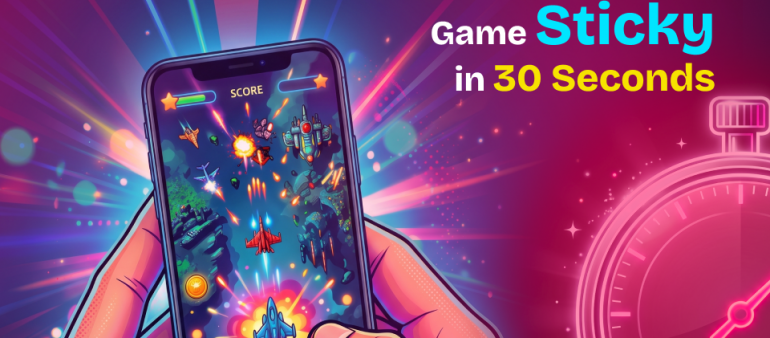
You know the game. You downloaded it because a fifteen second ad promised you could slice fruit, stack blocks, or squish a tiny blob through a maze. You said you'd play once. Forty minutes later you're still there, thumb cramping, muttering "okay one more run" for the ninth time. That's a hyper-casual game doing its job, and its job starts and basically ends in the first thirty seconds.
Hyper-casual games are the fast food of mobile gaming. No tutorials, no long story, no seventeen currencies to figure out. You open the app and you're already playing, usually before you've even decided if you like it. And that's the whole trick!
These games don't get thirty minutes to win you over the way a console game might. They get thirty seconds, sometimes less, before your thumb drifts back to the home button. So every single choice a game app developer makes in that opening window has to earn your attention on the spot.
The Grandma Test
Good hyper-casual games pass what developers half-jokingly call the grandma test. Could your grandma, who has never touched a phone game in her life, understand what to do within two seconds of the screen loading? If the answer is no, the game is already in trouble.
There's no room for instructions or pop-ups explaining mechanics. The visuals themselves have to scream the goal. A ball rolling toward a gap. A tower that needs one more block. A line that needs to dodge a wall. You should be able to mute the sound, ignore the text, and still know exactly what you're supposed to do.
Juice Makes Everything Feel Alive
Game developers throw around a weird word for this next part: juice. Juice is all the extra flair layered on top of basic mechanics. The screen shakes when you land a hit. The satisfying pop when a block snaps into place. The little wobble before something explodes into confetti. None of it changes how the game actually works, but it changes how the game feels, and feel is everything in the first thirty seconds. A game that looks flat and quiet gets deleted. A game that crunches, bounces, and sparkles at every tap keeps a thumb glued to the screen a little longer, even if the core gameplay is honestly pretty simple underneath it all.
Fail Fast, Try Again Faster
Here's the part that sounds backward until you think about it.
A sticky hyper-casual game wants you to fail. Fast. Losing a run in three seconds and getting dropped right back into a fresh attempt, with zero loading screen and zero friction, is what keeps players hooked. This is the near-miss trick your brain falls for every single time. You didn't lose because the game was unfair. You lost because you were one pixel off, and your brain insists the next run will be the one. That itch to try again immediately is the whole engine behind hyper-casual retention, and developers design failure states just as carefully as they design winning ones.
One Goal, Zero Confusion
The best hyper-casual titles resist the urge to add more. More power-ups, more currencies, more menus, more everything. Every extra system you bolt on adds a moment where a new player has to stop and think, and thinking is the enemy of stickiness.
The goal has to stay embarrassingly simple: stack higher, run farther, cut cleaner. Instead of being a limitation, simplicity is the entire design philosophy, and it's why a game built by a two-person team can go viral just as easily as one backed by a huge studio budget.
Put all of this together and you get a strange kind of magic trick. A game with almost no story, almost no depth, and almost no learning curve somehow ends up more addictive than titles ten times its size. That's the entire art of hyper-casual design: hook someone before they've even decided to give you a chance, and make the loop so satisfying they forget to check the time.
Got a Hyper-Casual Idea Rattling Around in Your Head?
This is exactly the kind of game Logic Simplified loves building. With over 12 years of experience shipping casual, action, puzzle, card, and hyper-casual titles across iOS, Android, and beyond, the team knows how to nail that crucial first-thirty-seconds hook instead of just hoping for it.
You bring the idea, and Logic Simplified's team preps a free Game Design Document and a free quote before you commit to anything, then builds it out using their own library of ready-to-go game code, which is exactly how they keep timelines short and costs lower than most studios can manage.
If you want your game to be the one someone can't put down at 2 a.m., write to us at enquiry@logicsimplified.com or get in touch here.