+ 44 203 372 4609
 Logicsimplified
 Get a Quote



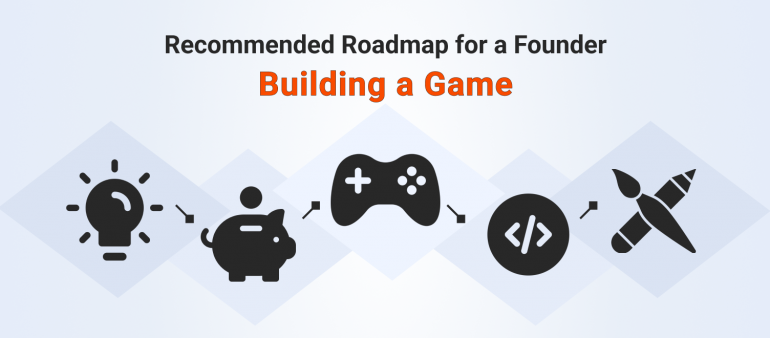
Every founder who walks into game development thinks they know what they're signing up for. Then reality hits: the scope creeps, the budget bends, and the six-month project becomes an eighteen-month grind. If you're serious about game development in 2027, you don't need more motivation, you need a roadmap that tells you exactly what to do, in what order, and why.
This is the roadmap for any founder building a game today. It's not a theory but the sequence that separates studios that ship from studios that stall.
Understanding Game Development in 2027
Before you write a line of code, understand the landscape you're entering. Game development today is not what it was five years ago. Player expectations are higher, platforms are more fragmented, and indie game development has become both more accessible and more competitive at the same time. Engines like Unity, Unreal and Roblox have lowered the technical barrier, but that same accessibility means thousands of other founders are chasing the same players' attention.
This is why games fail despite good development. The founders who succeed aren't the ones with the biggest budgets, they're the ones who treat how to make a video game as a structured business problem, not just a creative one, and have the success metrics defined from the get go. That mindset shift is the real starting point of this roadmap.
Step 1: Nail Your Game Design Document
Every solid roadmap begins with a solid game design document (GDD). It's the single reference point your entire team, and eventually your investors or publishers, will use to understand what you're building.
A strong GDD should cover:
- Core gameplay loop and mechanics
- Target platform(s) and technical requirements
- Art direction and narrative framework
- Monetization approach (more on this below)
- Milestones and scope boundaries
Founders often confuse game design with game development, and it's worth being precise here. There's a real difference between game design and game development. Design is the "what" and "why" are the rules, systems, and experience you're crafting. "How" is the development, the engineering, art production, and technical execution that turns that design into a playable product. Your GDD lives entirely in the design phase, and getting it right before development begins is what prevents the most expensive kind of rework which is rebuilding systems because nobody agreed on what they were supposed to do in the first place.
Sign up for your free 20-minutes of GDD consultation. Get in touch, today!

Step 2: Map Your Game Dev Roadmap
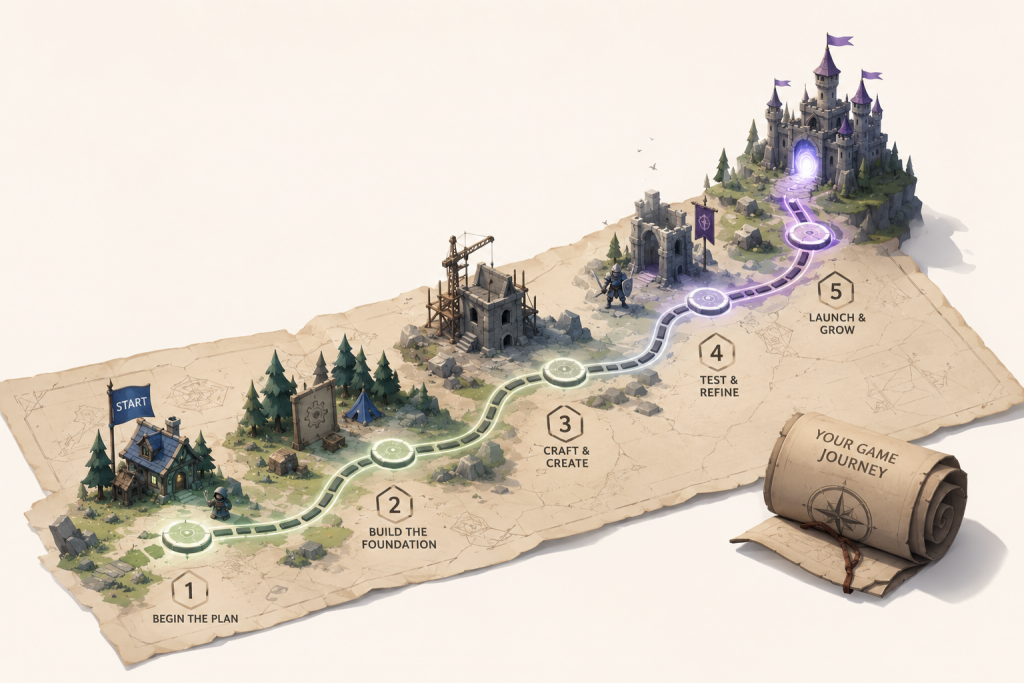
Once your GDD is locked, it's time to build your actual game dev roadmap. This is where founders either set their studio up for a controlled, predictable production cycle or set themselves up for burnout.
A realistic roadmap breaks your project into phases:
- Pre-production:- prototyping core mechanics and technical proof of concept
- Production :- building content, levels, art, and systems at scale
- Alpha :- features-complete but unpolished
- Beta :- polish, bug fixing, playtesting
- Launch and post-launch support
Attach a realistic game development timeline to each phase, and don't skip setting concrete game development milestones along the way. Milestones aren't just for tracking progress, they're checkpoints that force honest conversations about scope, budget, and whether the game is still fun. Founders who skip milestone planning tend to discover problems only when it's too late and expensive to fix them.
Step 3: Understand How to Build a Game the Right Way
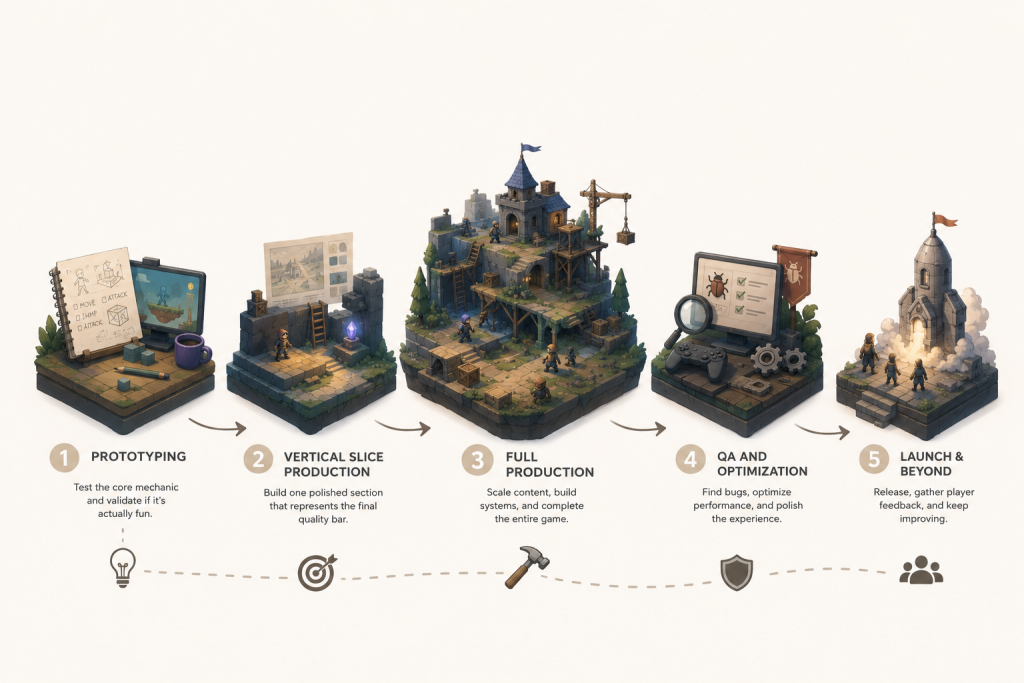
Knowing how to build a game well means understanding the full video game development process, not just the coding part. Development typically flows through:
- Prototyping:- testing whether the core mechanic is actually fun before investing further
- Vertical slice production:- building one polished section that represents the final quality bar
- Full production:- scaling content across the whole game
- QA and optimization:- the unglamorous work that determines whether players stay or churn
One mistake I see founders make constantly: they treat prototyping as optional and jump straight into full production. That single decision is often the answer to the question every founder eventually asks: why do video games take so long to make? Skipping validation early means you discover mechanical or scope problems deep into production, when fixing them costs far more time than testing them upfront would have.
Step 4: What Beginners should Avoid in Game Development
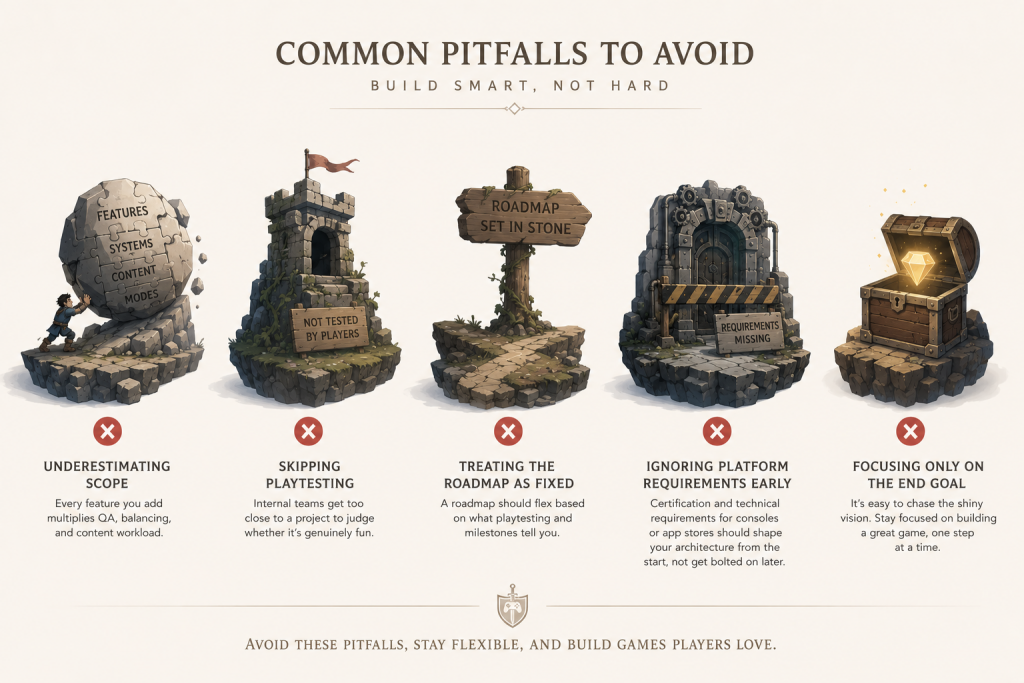
If this is your first time leading a studio, treat my advice seriously, even if you have deep experience in another industry. The most common first-time founder mistakes are:
- Underestimating scope. Every feature you add multiplies QA, balancing, and content workload.
- Skipping playtesting. Internal teams get too close to a project to judge whether it's genuinely fun.
- Treating the roadmap as fixed. A roadmap should flex based on what playtesting and milestones tell you. It's not to stay frozen from day one.
- Ignoring platform requirements early. Certification and technical requirements for consoles or app stores should shape your architecture from the start, not get bolted on later.
- Focusing only on the end goal. It’s easy to chase the shiny vision. Stay focused on building a great game, one step at a time.
Founders who internalize these lessons early save themselves months of costly correction later.
Step 5: Plan Your Game Monetization Strategy Early
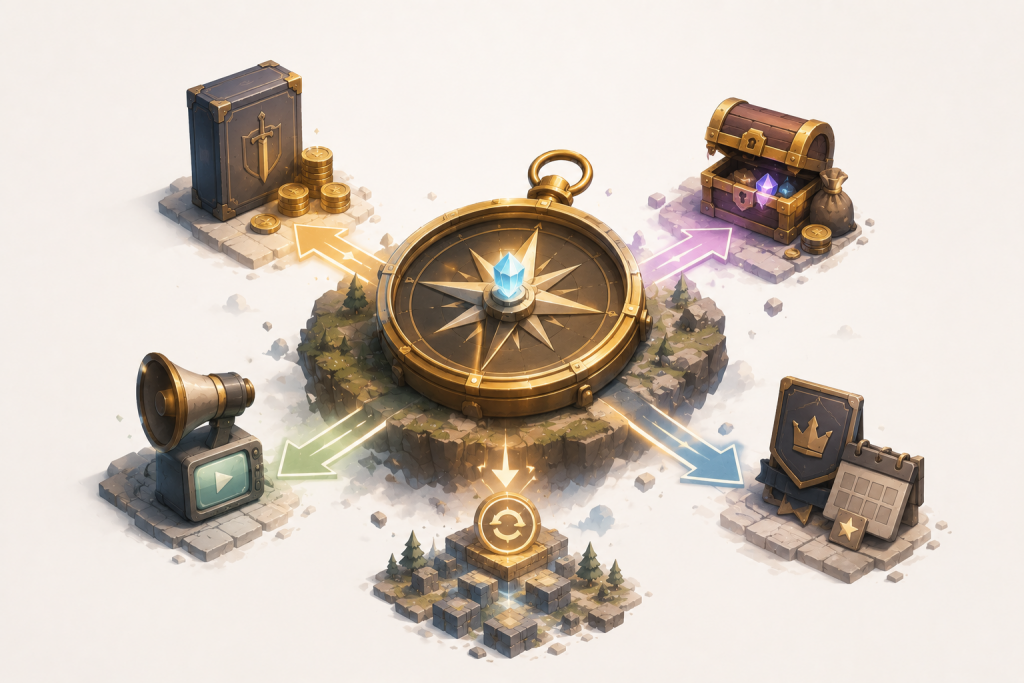
Your game monetization strategy shouldn't be an afterthought bolted on right before launch. It should shape design decisions from day one. Whether you're building a premium title, a free-to-play game with in-app purchases, a subscription model, or a hybrid approach, the monetization model changes how you design progression, pacing, and content pipelines.
Decide early:
- Will your revenue come from upfront purchase, ongoing purchases, ads, or a mix?
- How does monetization align with player experience without feeling exploitative?
- What live-ops or content-update cadence does your model require post-launch?
Retrofitting monetization into a finished game is one of the most disruptive changes a studio can make. Build it into your roadmap from the start.
Our clients value us for making games that help tick all the three boxes - acquisition, retention, and monetization. Know who they are!
Step 6: Learn How to Market a Video Game Before You Launch
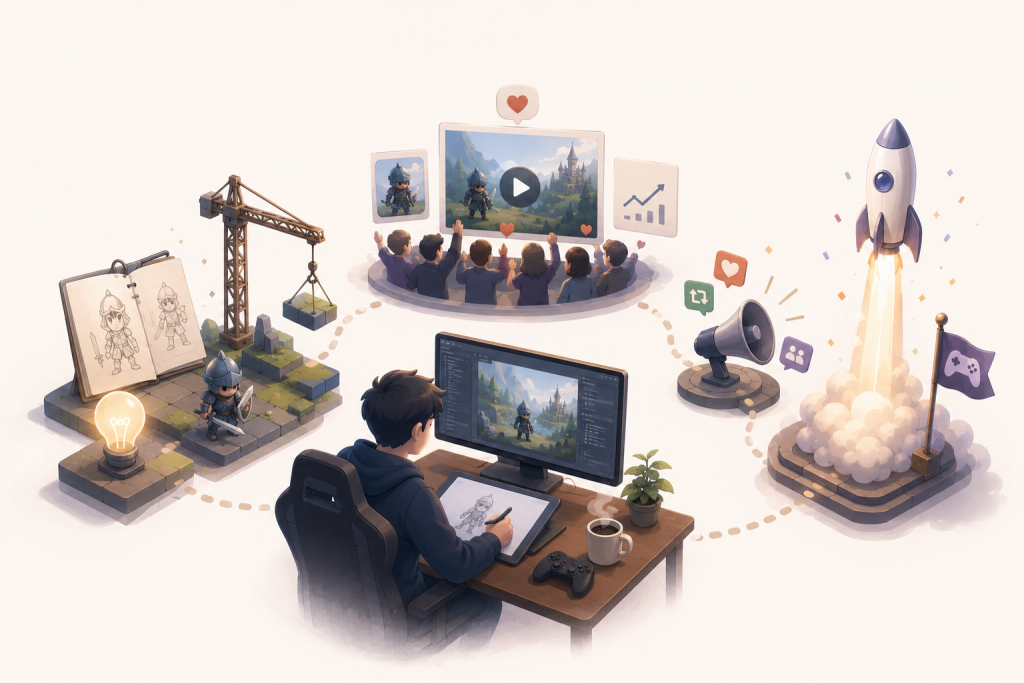
Marketing is not a launch-week activity, it's a parallel workstream that should run alongside development. Understanding how to market a video game means building visibility long before your release date: community building, wishlist campaigns, influencer outreach, and press relationships all take months to compound.
For smaller studios, an indie game marketing strategy doesn't require a massive budget, it requires consistency. Share development progress, build a Discord community, participate in relevant events, and treat every trailer or dev-log as a chance to grow an audience that's ready to convert the moment you launch.
Common Questions Founders Ask Along the Way
How long should a game development roadmap actually take? It depends entirely on scope, but most indie titles run anywhere from 12 to 24 months from prototype to launch. The founders who hit their timelines are the ones who protect their pre-production phase, which is rushing prototyping to "get to the real work" almost always backfires later.
Do I need a publisher, or can I self-publish? Both paths are viable in 2027. Publishers bring funding, marketing muscle, and platform relationships, but they also take a cut and some creative control. Self-publishing keeps you in full control of your monetization strategy and roadmap, but puts the marketing and funding burden entirely on you. Many founders start conversations with publishers around the vertical slice stage, once there's something tangible to show.
What's the biggest roadmap mistake you see repeatedly? Treating the roadmap as a document you write once and never revisit. The best studios review their roadmap at every milestone, comparing what they planned against what playtesting and production actually revealed, and adjusting scope accordingly rather than pretending the original plan was perfect.
Bringing It All Together
A successful game is not only the product of talent alone but also the product of a disciplined roadmap: a clear design document, realistic milestones, a development process that validates ideas before scaling them, a monetization plan built in from day one, and marketing that starts long before launch.
If you're a founder who wants that roadmap executed by a team that's lived through every phase of it, that's exactly where Logic Simplified comes in. As a top game development company in India, we've been developing games since 2011, working with founders and studios across every stage of the process. From early prototyping and game design documentation through full production, QA, and post-launch support. Over more than a decade, we've helped turn early-stage concepts into shipped, monetized, and successful games across platforms.
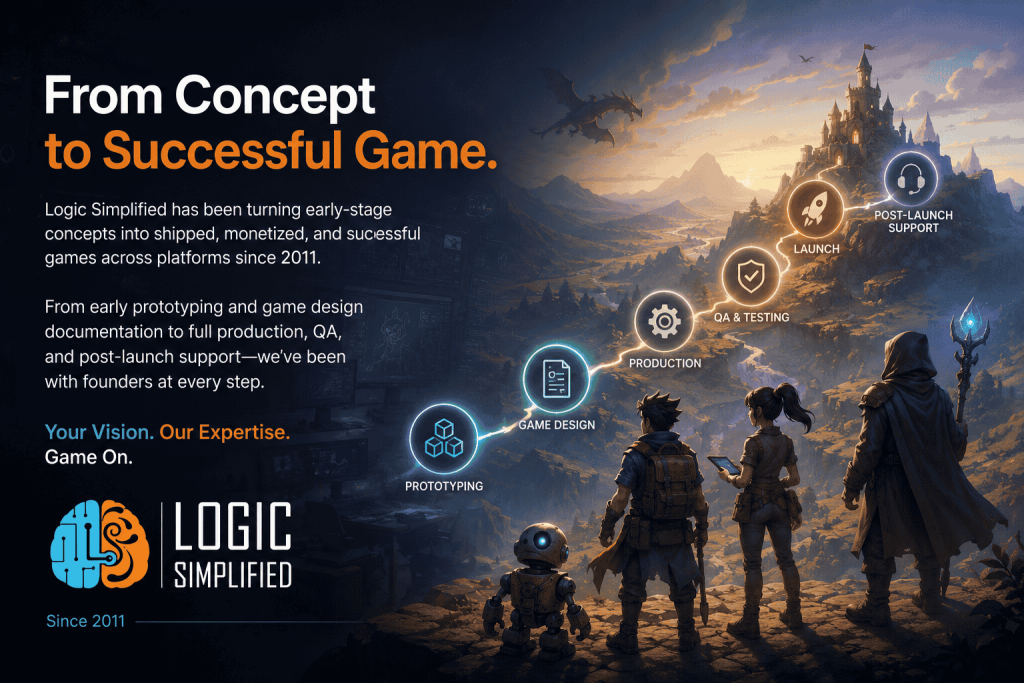
In 2027 and beyond, success belongs to teams that treat game development and game business with equal seriousness. Logic Simplified is a game development company with the finest, most creative game concept artists, 2D and 3D game designers, and UX designers. As a top game development company for Unity and Unreal, we build games across genres, like puzzle games, card games, board games, and more. Our clients value us for making games that help tick all the three boxes - acquisition, retention, and monetization. Get in touch with us at enquiry@logicsimplfied.com and share your game idea.
Building a game is still hard. But it doesn't have to be a guessing game. With the right roadmap and the right partner it's a process you can plan, budget, and execute with confidence. Write to us at enquiry@logicsimplified.com, or get in touch here.