+ 44 203 372 4609
 Logicsimplified
 Get a Quote



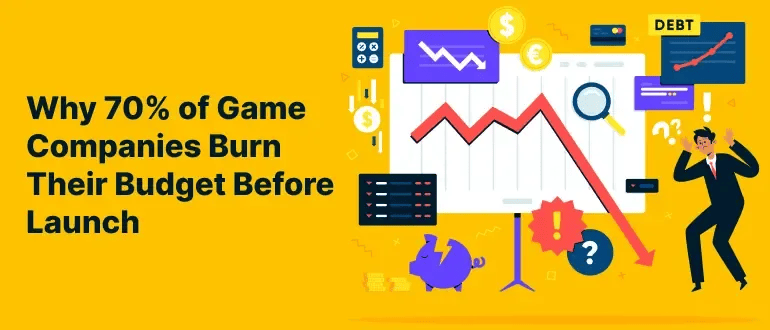
Every year, thousands of startup game companies enter the industry with confidence, fresh ideas, and early funding, convinced they will build the next big hit, or start their own online game business. Yet, more than half shut down before their game ever reaches beta.
It’s a failure of execution, process, and financial discipline. The money disappears faster than the game takes shape.
At Logic Simplified, we've partnered with founders building everything from mobile apps and casino games to PC titles and gamification systems. We’ve seen the same pattern repeat: people drastically underestimate the process, the cost, and the discipline required to succeed.
To truly understand this, it helps to start with a real-world warning.
The Cautionary Tale: How One Studio Wasted Its Seed Fund in 4 Months
A young entrepreneur came to us with a puzzle game idea. He had already:
- Rented a large, expensive office.
- Hired multiple senior artists and developers.
- Invested heavily in equipment.
However, when we evaluated his project, we found no clear Game Design Document (GDD), no validated core loop, and no realistic budget. In just four months, he had exhausted most of his funds - without building a single playable prototype.
What failed wasn't his vision. What failed was his process.
This founder's experience is tragically common. It illustrates the most critical reasons why new studios incinerate their budgets before they even have a compelling gameplay demo.
The 10 Budget Killers: Why Startups Lose Money Before Launch
1. The Cost Trap: Underestimating the True Investment
Founders often seek a simple, fixed development cost. But the price of a game can be variable and tied to its complexity: genre, art style, world size, backend requirements, platform, and monetization model.
- A simple casual board game may cost little.
- A multiplayer RPG or a complex casino platform can cost millions.
Most startups begin with an incomplete budget and a naïve understanding of the technical scope. By the time they realize the real cost, their burn rate has already exhausted the seed money.
2. The Blueprint Blunder: Skipping the Game Design Document (GDD)
The single biggest early mistake is neglecting the GDD. Without this structured blueprint, the team is rudderless:
- Developers build features that are later scrapped.
- Artists create assets that don't match the gameplay.
- Designers change the core vision every few weeks.
Every directional shift is a hemorrhage of time and money. A rock-solid GDD is not a formality; it is the financial firewall that prevents costly rework.
Experts at Logic Simplified create fool-proof GDDs for our clients’ game ideas. Tell us about yours, and let’s take it forward.

3. The Ego Trap: Hiring a Full Team Too Early
Startups feel pressure to look like a "real studio" immediately, hiring animators, multiple artists, writers, and engineers on day one. But early development only requires two things: a strong idea and strong design clarity.
The key sequence is reversed: You must hire game designers before hiring developers and artists. Designers define the vision; developers and artists execute it. Prematurely hiring a large team means paying hefty salaries long before actual production can begin.
4. The Massive Build Mistake: Skipping Fun Validation
The truth is simple: a game is successful only if the core loop is fun.
Many founders jump straight into full production, building levels, characters, UI, environments, and features before confirming that the basic experience is enjoyable. This leads to massive builds, huge asset creation, and complex mechanics - none of which should happen before validating the fun factor with a simple, small prototype.
Skipping early testing is the quietest, most expensive mistake in the industry.
5. Monetization as an Afterthought: Leaving Money Until the End
Monetization is not a skin you add later. It fundamentally affects:
- Level pacing and reward design.
- Difficulty patterns and progression speed.
- Store structure and item value.
If you design the entire game first and think about revenue later, you will have to rebuild everything from the ground up. Money must be treated as a design pillar, defined on Day 1.
6. The Personal Bubble: Building What You Like, Not What Players Want
Founders often fall in love with their personal vision. But the player audience has different priorities: simplicity, clarity, reward timing, and balance.
When companies forget the player's perspective, the game drifts in the wrong direction. Testing mechanics with real users early is the only antidote. Ignoring the audience guarantees expensive redesigns and wasted resources.
7. The Uncontrolled Scope Creep: Changing the Vision Mid-Flight
While scope changes are inevitable, uncontrolled changes destroy budgets. A founder who constantly adds features, switches the art style, or alters mechanics forces the entire team into perpetual rework mode.
Every change reshapes design, art, code, testing, and backend structures. Small edits quickly snowball into massive costs. Disciplined production is the only way to prevent runaway spending.
8. The Partner Peril: Choosing the Wrong Development Vendor
Some startups choose freelancers who can't scale; others hire agencies with no genuine gaming experience. Many are lured by low-cost promises, only to find the work must be rebuilt from scratch later.
A reliable game development company saves money through:
- Accurate scoping and tight documentation.
- Proper tech planning and experienced designers.
- Efficient development cycles.
The wrong partner will double your cost. The right partner prevents the mistakes that crush most new studios.
Logic Simplified is a globally trusted name in game design and development services. Get in touch for a free consultation.
9. The Live Ops Blindspot: Forgetting Post-Launch Requirements
A game is not "done" at launch. The real work begins after launch. Startups frequently run out of funds right when they need them most because they only budgeted for development, ignoring crucial live operations:
- Live events and content drops.
- Server scaling and bug fixes.
- Marketing and community support.
10. The Rush to Release: Skipping Critical Development Stages
Successful studios build games in layers:
- Prototype (Validate Fun)
- Vertical Slice (Define Look/Feel)
- Alpha / Beta (Test Stability)
- Soft Launch (Validate Metrics)
- Global Release
Most startup companies try to jump straight from idea to full production—without validation, without testing, without iteration. This accelerates failure and burns resources faster than anything else.
The Action Plan: How to Achieve Predictable Success
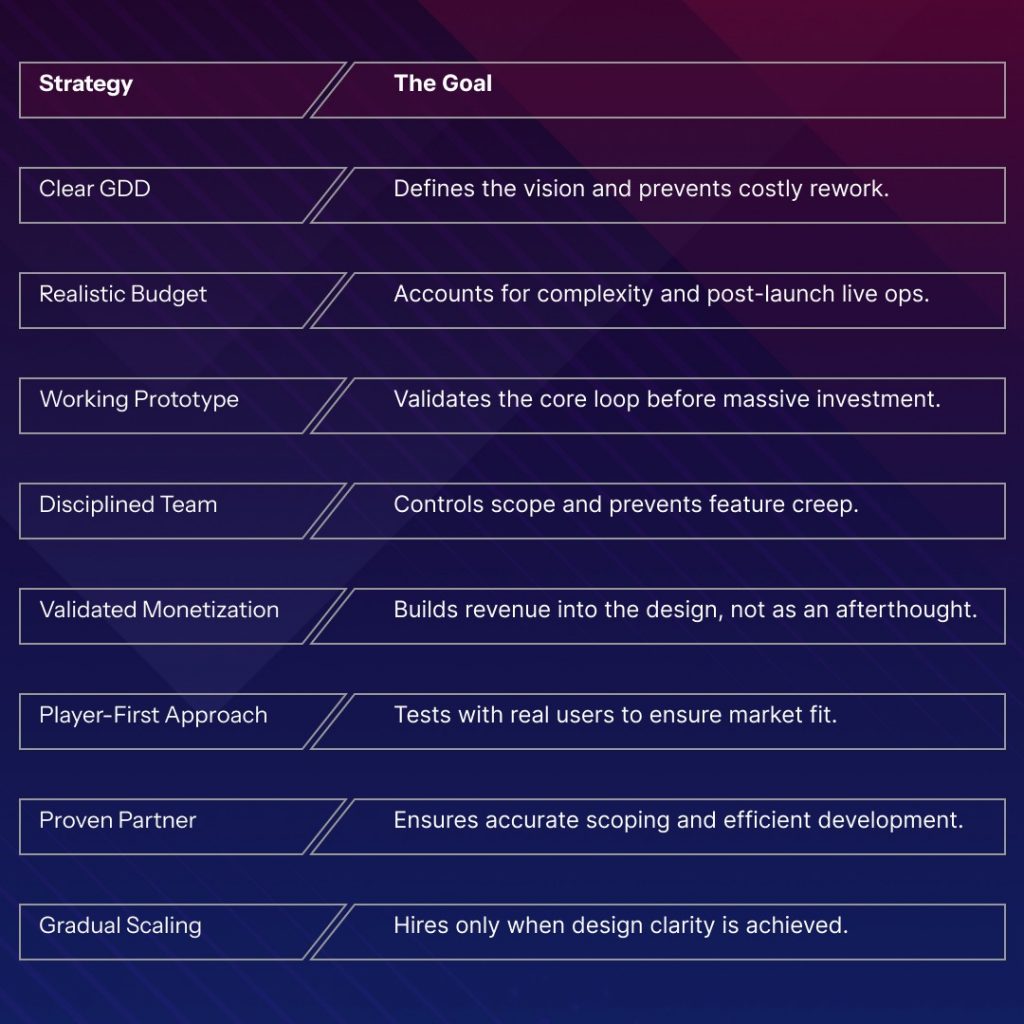
To avoid the common failures that crush most new studios, founders must establish a framework of discipline and validation. Focus on these fundamentals:
Final Thoughts
Game development is a complex, high-risk journey. But with the right approach and the right partners, it becomes predictable, structured, and financially controlled.
Most startup game companies fail because they rush, assume, overbuild, and underestimate. Your ultimate goal must be the opposite: Plan clearly, build smart, test often, and spend wisely.
Logic Simplified has the finest, most creative game concept artists, 2D and 3D game designers, and game app developers. As a top game development company, we build multiplayer games with excellent player experiences, while decreasing server expenditures and maintaining equitable gameplay. Our clients value us for making games that help tick all the three boxes - acquisition, retention, and monetization. Get in touch with us at enquiry@logicsimplfied.com and share your game idea.