+ 44 203 372 4609
 Logicsimplified
 Get a Quote



As we enter 2026, the global gaming industry has transitioned from a period of "market correction" (2023–2025) into a new era of explosive, structurally different growth. The future of gaming is no longer defined merely by polygon counts, but by the convergence of AI in gaming, cloud infrastructure, and community-driven economies.
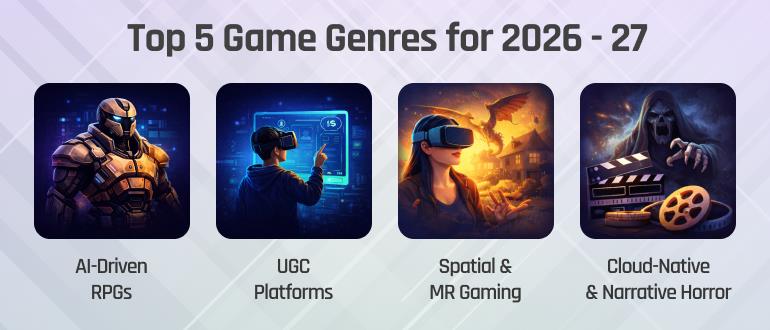
For leaders looking to capture market share, the focus must shift toward genres that offer high "Defensibility" and "LTV" (Lifetime Value). Based on current video game industry trends, here are the five game genres poised for the most significant growth in 2026-27.
1. AI-Driven RPGs (Role-Playing Games)
The best RPGs of 2027 are solving the industry's greatest pain point: the astronomical cost of manual content creation. By integrating AI in gaming directly into the development pipeline, studios are now producing "Living Worlds" that adapt to player choice in real-time.
According to recent market analysis, over 20% of new titles on Steam in late 2025 utilized Generative AI for core mechanics, a 100% increase year-over-year. AI reduces production timelines by an estimated 30-40%, allowing for more frequent content updates and lower churn.
I am eagerly waiting for The Elder Scrolls VI (Bethesda) as it is anticipated to be the flagship for AI-driven NPC behavior and environmental persistence also Cyberpunk 2077: Rewired its a reimagining that uses "Metahuman" technology for more realistic, AI-responsive social interactions.
Generative AI now powers "Living NPCs" that possess persistent memory. In 2026-27, players will not just follow a script, they will influence the world in ways the developers didn't even pre-program.
2. User-Generated Content (UGC) Platforms
UGC has moved from a "feature" to its own dominant category among game genres. Platforms like Roblox and Fortnite have effectively become the "social media of gaming."
In 2025 alone, Roblox creator payouts reached nearly $1.5 billion. Roblox now hosts over 100 million distinct experiences. Fortnite Creative is also utilizing the "Unreal Editor for Fortnite" (UEFN) to allow professional studios to build branded worlds.
The best thing about user generated content is that it has Zero production risk. The community creates the content, the platform holder takes a commission on all transactions within that economy.
These are no longer just games, they are engines. In 2026, we are seeing "pro-creator" tools that allow small teams to build AAA-quality experiences within existing platforms, instantly accessing millions of players.
This model outsources the risk of innovation to the community. For a C-suite leader, this represents a shift from "Project Funding" to "Platform Governance."
3. Spatial & Mixed Reality (MR) Gaming
The launch of mid-tier MR headsets (like the rumored Meta Quest 4 and Vision Pro "Lite") has shifted focus from VR isolation to "Spatial Computing." This is one of the most vital video game industry trends to track for non-endemic brands (Retail, Auto, etc.).
VR/AR/MR market size is projected to reach $26.9 billion in 2026. Gaming remains the fastest-growing segment within this at a 30.4% CAGR.(https://www.mordorintelligence.com/industry-reports/virtual-augmented-and-mixed-reality-market)
I checked out Cabal Hunt during the research and found it to be a breakthrough Afro-Centric adventure game using MR to overlay mythological spirits onto the player's physical environment. Also Star Wars Outlaws 2 (Spatial Edition) has Integrated MR dogfights into real-world living spaces.
The use of AI in gaming for environment mapping allows games to understand a user’s living room. A "strategy game" now takes place on your coffee table, interacting with real-world objects.
This genre is the "Gateway to Contextual Commerce." It allows brands to place digital assets in physical spaces, creating a new bridge for advertising and direct-to-consumer sales.
4. Cloud-Native & "Frictionless" Casual
In 2026, "instant play" is the gold standard. Cloud gaming is expanding the market to the 4 billion people who own a smartphone but do not own a gaming console.
Cloud gaming revenue is expected to surge to over $18 billion by 2030. The "casual" segment accounts for over 40% of this growth, as it caters to "pick-up-and-play" users.
Monopoly GO! (Cloud Edition) is the best example of a game streamable instantly via social media links. Netflix Games Hub is delivering console-quality titles like GTA via their existing streaming infrastructure and not to forget Jio Games ready to dominate the Indian market with their cloud gaming space.
Compression algorithms and edge computing have reduced latency to the point where "cloud-native" feels local. This has opened the door for "instant-play" social ads and frictionless cross-platform play. This expands the Total Addressable Market (TAM). You are no longer selling to the 300 million people with consoles; you are selling to the 4 billion people with a high-speed internet connection.
5. Interactive Cinema & Narrative Horror
The line between a "game" and a "prestige TV series" is vanishing. This genre is growing because it allows for "asset sharing" using the same 3D models for a game, a movie, and a marketing campaign.
Narrative-driven horror has seen a 40% increase in engagement among Gen Z, largely driven by "discoverability" on platforms like TikTok and YouTube.
OD (Hideo Kojima) is an experimental horror project developed in partnership with Jordan Peele, leveraging cloud-powered cinematic realism. Project M is a photorealistic interactive story that uses AI-driven facial animation to mimic movie-quality performances.
Leveraging Unreal Engine 5.5, these games offer photorealism that rivals big-budget films. These titles act as the "hub" for transmedia IP. A single set of 3D assets can now be used for a game, a streaming series, and a virtual theme park experience.This is an "IP De-risking" play. By launching a narrative game first, companies can test a story's viability before committing hundreds of millions to a cinematic production.
Strategic Conclusion: The 2027 Roadmap
The future of gaming is a landscape defined by hybridization. We are seeing RPGs that are also social platforms, and casual games that offer AAA-level cinematic quality through the cloud. For organizations looking to thrive in 2027, the directive is clear:
- Prioritize AI-Assisted Pipelines: To manage the rising costs of "Best RPG" expectations.
- Lean into UGC: To capture the network effects of the creator economy.
- Invest in Frictionless Access: To ensure your services are available anywhere, on any screen, at any time.
Logic Simplified is at the forefront of these structural shifts. We provide the strategic consulting and technological integration services needed to turn these video game industry trends into your company's competitive advantage. As a top game development company, our game app developers also build multiplayer games with excellent player experiences, while decreasing server expenditures and maintaining equitable gameplay. Our clients value us for making games that help tick all the three boxes - acquisition, retention, and monetization. Get in touch with us at enquiry@logicsimplfied.com and share your game idea.