+ 44 203 372 4609
 Logicsimplified
 Get a Quote



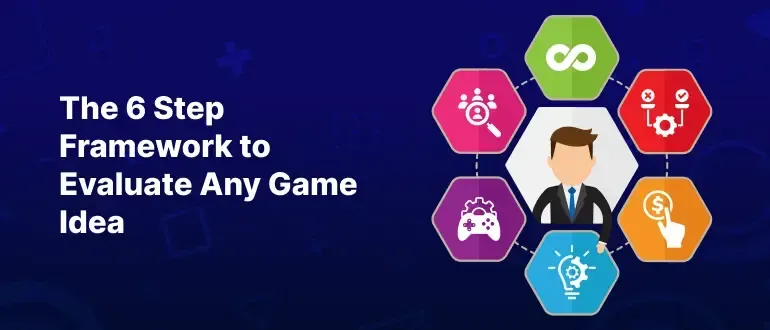
Most great game ideas do not fail because they are bad. They fail because no one checked if they were worth building. At Logic Simplified, our team has spent years refining the way we examine game development ideas for studios, casinos, and gamification brands. After building hundreds of titles, we created a 6 step framework that helps us separate strong ideas from ideas that only sound good in meetings.
To make this more relatable, here is a quick story.
The Game That Looked Perfect But Was Not
A few years ago, a startup came to us convinced they had a game changing racing title. Their deck looked impressive. The artwork was beautiful. Their list of features was long.
But when we put their idea through our evaluation process, we discovered:
- The core fun loop was unclear.
- The target audience did not match the gameplay.
- The game design document was inconsistent.
- The monetization plan lacked logic.
- The technical complexity was far higher than their budget allowed.
- The gameplay did not bring anything unique to the market.
We restructured the idea using the framework below. After changes, their refined concept went on to cross more than 5 million active users. This is why every idea needs a structured review.
Step 1: Define the Core Experience
Every successful game defines how it wants players to feel within the first 30 seconds. Whether it is the constant micro wins in Candy Crush Saga or the short competitive intensity of Clash Royale, the emotional outcome drives retention. If the primary repeated action is not satisfying, additional features will not fix it. Clarity at this stage prevents expensive redesigns later.
Step 2: Build a Mini Game Design Document
Many startup game companies skip documentation and immediately hire game designers. This often results in scope creep and shifting priorities. A concise 6 to 10 page Game Design Document outlining genre, progression, monetization, platform, and technical expectations creates alignment early. It does not slow innovation. It protects it. Clear structure makes cost estimation far more realistic.
Step 3: Identify Audience and Market Fit
A game is built for players, not internal enthusiasm. We analyze player motivations, platform preferences, engagement patterns, and competitor positioning. Even companies like Supercell heavily test audience behavior before scaling products such as Clash of Clans. When audience alignment is ignored, even technically strong games struggle to retain users.
Step 4: Test the Core Fun Loop
The core loop determines survival. Every strong loop follows a simple cycle: action, reward, progress, repeat. At this stage, visual polish is irrelevant. We test prototypes, clickable demos, and simplified simulations to measure engagement. If the loop does not hold attention in a basic version, it will not succeed after full production.
Step 5: Check Technical Feasibility
This is where the question, how much does it cost to develop a video game becomes practical. Cost depends entirely on technical depth. Multiplayer systems, backend architecture, real time synchronization, physics simulations, and scalability requirements dramatically affect budgets. A responsible game development company evaluates engineering complexity before promising timelines or fixed costs. Without feasibility validation, financial projections are speculation.
Step 6: Validate the Monetization Strategy
A well designed game without sustainable revenue logic cannot survive. Ads, in app purchases, subscriptions, and economy balance must align with player psychology. Monetization should feel natural within gameplay, not forced. When revenue design matches user behavior, performance becomes predictable rather than accidental.
This 6 step framework works because it removes emotional decision making and replaces it with structured evaluation. It protects capital, aligns teams, and reduces the risk of failed launches. Before you hire game app developers or finalize a partnership with a game development company, your idea should pass this screening process.
For startup game companies operating with limited runway, discipline is not optional. The smartest founders do not begin by asking how much does it cost to develop a video game. They begin by validating whether the idea deserves to be built at all.Logic Simplified is a Game Development Company with the finest, most creative game concept artists, 2D and 3D game designers, and UX designers. As a top game development company for Unity and Unreal, we build games across genres, like puzzle games, card games, board games, and more. Our clients value us for making games that help tick all the three boxes - acquisition, retention, and monetization. Get in touch with us at enquiry@logicsimplfied.com and share your game idea.