+ 44 203 372 4609
 Logicsimplified
 Get a Quote



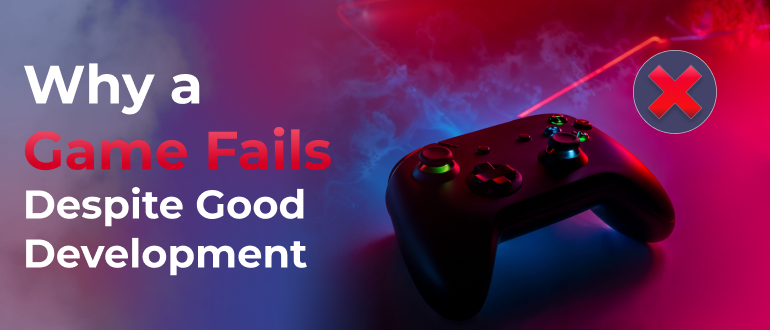
The graveyard of gaming is full of technically brilliant titles that nobody played. The brutal truth is that great game development is only one piece of the puzzle. In the modern landscape, a game lives or dies by decisions made outside the code editor.
Let's break down exactly why games fail even when the development is good and what every indie game developer, studio, or publisher needs to understand before hitting that publish button.
1. Poor Game Marketing: The #1 Silent Killer
The single biggest reason well-made games fail is invisible: nobody knows they exist.
Game marketing is not optional anymore. With over 10,000 games released on Steam every year, discoverability is the real battleground. A polished game with zero marketing strategy will be buried under the avalanche of new releases within 48 hours.
What a solid game marketing plan looks like:
- Building an audience at least 6 - 12 months before launch (Discord servers, Reddit, Twitter/X devlogs)
- Running a compelling Kickstarter or Steam Next Fest demo to generate wishlists
- Engaging with gaming journalists, YouTubers, and streamers well in advance
- Consistent social media content that shows the personality behind the game, not just screenshots
Most developers treat marketing as an afterthought. The studios that succeed treat it as a parallel development track.
2. Wrong Game Monetization Models Destroy Trust
Even when players find a game, a broken or predatory game monetization structure can poison the well instantly.
Choosing the wrong game monetization models is a critical error. The model has to match your genre, your audience, and the platform you're on. Here's how mismatches typically play out:
- Premium price on a casual mobile game → players ignore it in a sea of free-to-play options
- Aggressive pay-to-win mechanics in a competitive title → community outrage, review bombs, and refunds
- Subscription on a small indie title → the value perception simply isn't there
- No monetization post-launch → the studio can't survive to update or support the game
The most successful studios think about game monetization strategy from day one, not after launch. That means asking early: Is this a $4.99 premium mobile game? A $29.99 PC title with cosmetic DLC? A free-to-play with a battle pass? Each model requires a completely different game design and audience relationship.
Video game monetization that feels fair keeps players around. Monetization that feels exploitative ends communities overnight.
3. No Clear Video Game Marketing Strategy
Having a budget for ads isn't the same as having a video game marketing strategy. Many developers confuse activity with strategy.
A real video game marketing strategy includes:
- Target audience definition - Who is this game actually for? Age, platform, genre preferences, competing games they already play
- Positioning - What makes this game different from the 200 others in this genre?
- Channel selection - TikTok for casual games, YouTube for story-driven RPGs, Twitch for competitive titles
- Launch window timing - Releasing against a major AAA title on the same day is a death sentence for smaller studios
For mobile studios especially, a mobile game marketing strategy needs to account for app store optimization (ASO), paid user acquisition (UA), creative testing, and cost-per-install (CPI) benchmarks, all before spending a dollar on ads.
The studios that get this right spend as much time on how to market a video game as they do on building it. The ones that don't produce video game flops, not because the game was bad, but because the strategy was nonexistent.
4. Ignoring Player Retention from Day One
Getting players to download your game is hard. Getting them to stay is harder. Player retention is the metric that separates games with thriving communities like Roblox, from games with dead servers six weeks after launch.
Most retention problems are baked into the design before launch:
- No onboarding hook - Players quit in the first 10 minutes if they don't feel immediate satisfaction
- No reason to return - Daily quests, seasonal content, and progression systems are retention mechanics, not just features
- No community loop - Multiplayer games die if matchmaking is empty; even single-player games need forums, modding tools, or social sharing hooks
The indie game community often overlooks retention because the team is so focused on just shipping. But a 30% Day-1 retention and a 5% Day-30 retention isn't just a business metric, it tells you whether players actually love what you built.
Studying how many indie game developers there are (estimates suggest over 10,000 active studios globally) gives context: with that level of competition, a game that doesn't retain players from the first session will be forgotten within weeks.
5. Broken or Mistimed Game Launch
Even with great development, great marketing, and a smart game monetization strategy, a botched launch can ruin everything.
Common launch mistakes include:
- Server infrastructure failure - If your game goes viral and your servers crash on Day 1, the negative press is permanent. Players don't give second chances easily.
- Critical bugs at launch - Releasing an unstable build because of deadline pressure creates a media narrative that's nearly impossible to reverse.
- Wrong pricing at launch - Launching too high and discounting too fast signals low confidence; launching too low devalues the product permanently
- Wrong timing - Launching the same week as a massive competitor steals all press and organic attention
People often ask why do video games take so long to make? The honest answer is that rushing the final 10% to hit an arbitrary date is responsible for a disproportionate number of video game flops. A delayed but stable launch almost always outperforms an on-time broken one.
6. Misunderstanding the Audience (Or Not Having One)
This is the meta-problem behind all the above. Many teams build a game they personally love, for an audience they never actually researched.
Understanding indie game meaning in the current market matters: indie no longer means "small budget passion project with no business plan." The most successful indie studios today approach audience-building like a business, gathering community feedback during development, running playtests, and making strategic genre choices based on market gaps.
Questions every team should answer before development begins:
- Who is already playing games in this genre, and why?
- What do they complain about in reviews of competing games?
- What platform do they prefer, and what are the platform's algorithm and store dynamics?
- What price are they used to paying?
The reason why video games often fail isn't technical, it's that the game was built in isolation from the people it was meant to serve.
The Bottom Line
Good development is necessary, but it is not sufficient.
A technically excellent game can fail because of poor game marketing, a mismatched game monetization model, a nonexistent video game marketing strategy, low player retention design, a chaotic launch, or a complete misreading of the audience.
In 2026 and beyond, success belongs to teams that treat game development and game business with equal seriousness. Logic Simplified is a game development company with the finest, most creative game concept artists, 2D and 3D game designers, and UX designers. As a top game development company for Unity and Unreal, we build games across genres, like puzzle games, card games, board games, and more. Our clients value us for making games that help tick all the three boxes - acquisition, retention, and monetization. Get in touch with us at enquiry@logicsimplfied.com and share your game idea.